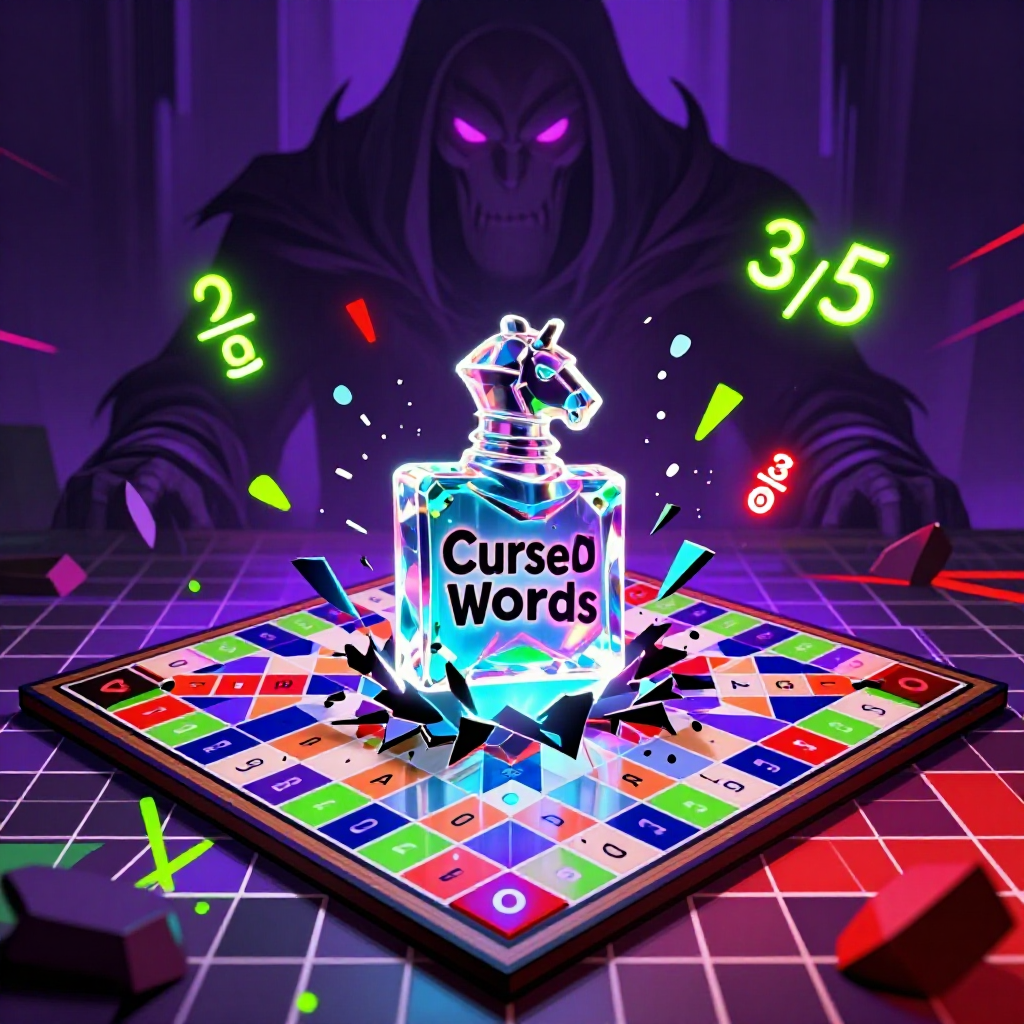
What I Wish I Knew Before Floor 6: Breaking Cursed Words
Let me guess your current situation. You downloaded Cursed Words thinking it was just a fun, spicy version of Scrabble. You booted it up, played a few early rounds, spelled some basic English words like “DOG,” “WATER,” “BUY,” “THIS,” or “GAME,” and thought you had it all figured out. You used your points to buy a few cool stickers to slap onto your tiles, effortlessly defeated a few minor enemies, and confidently assumed you were an absolute linguistic genius.
And then you hit Wave 11.
Or worse, you managed to stumble your way into the highly punitive, hidden Sixth Floor, where a giant troll with two million health absolutely obliterated your run while you were sitting there sweating, frantically trying to figure out if “ZA” is actually a real, playable word in the dictionary.
Don’t worry, because we’ve all been exactly there. On the surface, Cursed Words looks like a charming, simple little word puzzle game. But underneath that deceptive linguistic facade? It is a ruthless, mathematically insane roguelike that actively wants to break your spirit. Developed by Buried Things and published by Forklift Interactive, this game released on April 2, 2026, and it represents a total paradigm shift in the genre. It functions as a hybrid that fuses the foundational vocabulary mechanics of games like Scrabble or Boggle with the intense, rule-breaking synergy generation of heavy-hitters like Balatro and Slay the Spire.
I have spent a frankly embarrassing amount of hours testing all 11 unique playable characters, fighting all 16 highly aggressive “wordsmith” bosses, and dying over and over again to the absolute worst curses this game has to offer. I’ve collected gameplay data that you simply won’t find in basic tutorial tooltips. If you want to survive the grueling late game, you have to completely change your entire paradigm of how you play. It’s time to stop spelling entirely, and start breaking the game.
Here is exactly what I wish I knew before I hit Floor 6, compressing dozens of hours of my own miserable trial-and-error into one masterclass.
Rule #1: Stop Spelling. Start Doing Math.
When you first start a run, the gameplay loop is deceptively simple: the game rewards you for utilizing a grid of standard alphabetical letters to spell big, fancy words to meet base scoring thresholds. But as the difficulty curve steepens, the bosses get harder, and the enemy health bars get absolutely massive, the English language just isn’t going to cut it anymore.
Victory in Cursed Words requires abandoning the dictionary entirely. You have to pivot to the weird stuff and engage in complex mathematical tile manipulation. If you are still relying on your vocabulary by the time you reach the late-game encounters, you have already lost.
The Spatial Magic of the Knight Tile
Forget standard horizontal, vertical, and diagonal lines. While traditional word games mandate linear, adjacent spelling, Cursed Words introduces non-alphabetic tiles that fundamentally shatter these basic spatial constraints. As soon as you see a Chess Piece tile spawn in the shop, you need to buy it immediately.
The “Knight Tile” is easily one of the most spectacularly broken items in the entire game. It allows you to link tiles using the exact “L-shape” movement of a chess knight, completely bypassing standard linear adjacency rules.
Why is this so unbelievably good? Because it provides a massive vector for base score inflation. It lets you bypass all the useless junk tiles on the board and link up isolated Positional Multiplier Stickers. Imagine you place highly valuable consonant tiles—like a Z, Q, or X—on isolated multiplier squares across the far corners of your grid. By using the Knight Tile, you can link these distant multipliers into a single, continuous chain.
When you do this, the game’s underlying scoring algorithm calculates those multipliers concurrently rather than sequentially. The code essentially freaks out, meaning that triggering multiple isolated multiplier squares simultaneously results in compounding, rather than additive, base score inflation. It is literally free, exponential points.
The Dissolution of Language: Poker Hands and Fractions
Eventually, as you progress and unlock more of the game’s 300+ stamps and stickers, the game allows you to integrate Poker Hand Identifiers and Fractional modifiers. This represents the absolute dissolution of the game’s initial linguistic premise.
Poker Hand Identifiers are specialized tiles that score based on configurations like a “Full House” or a “Straight” rather than alphabetical spelling. You will also gain the ability to apply fractional modifiers (like 1/2 or 3/5) directly to your individual tiles.
Here is where the math truly breaks the game: when you use these two mechanics together, the application of a fractional sticker alters the base value of the entire hand rather than just the individual tile. If you apply a 3/5 fraction sticker to a tile that acts as the linchpin of a Full House configuration, the game’s engine multiplies the exponential base value of that Full House by the fraction before executing the final score calculation.
This pre-calculation compounding effect creates a wildly unintended multiplier loop. When the brutal bosses on waves 11 through 20 ask you for millions of points, this is exactly how you effortlessly eclipse their requirements.
Rule #2: Go Absolutely Feral
If you have ever played Slay the Spire, you probably know all about the famous “Claw” build—a strategic deck archetype where a specific card gets permanently stronger every single time you play it. Cursed Words has an analogous mechanic that serves as one of the most potent infinite-scaling engines in the game, known as the “Feral” synergy.
This strategic loop revolves around the acquisition of specific, low-cost word fragments or tiles that feature a unique, permanent modifier. Every single time a “Feral” tile is played during your run, its base point value permanently increases forever.
However, to successfully execute the Feral synergy, you must abandon traditional high-value spelling and focus entirely on “Card Draw” (tile cycling). You need to turn your board into an infinite loop. The optimal build requires the heavy implementation of Cost-Reduction modifiers and Draw Engine stamps.
By using your stamps to reduce the cost of playing the Feral tiles to zero, and combining it with a Draw Engine so that playing the tile immediately draws another tile from the reserve, you can cycle the Feral fragments dozens of times per turn. By the time you reach the late-game bosses, a single, tiny two-letter Feral fragment will mathematically output more points than a standard twelve-letter word. You just sit there and cycle it endlessly.
Rule #3: Physical Board Compression
The absolute final tier of synergy involves the physical alteration of the playing board geometry. In Cursed Words, stamps are used not just to modify the values of your tiles, but to physically alter the shape, layout, and constraints of the grid itself.
Certain characters among the 11-hero roster possess unique passive abilities that scale inversely with grid availability. By utilizing specific stamps to forcibly condense and shrink the board size, you can artificially trigger these character-specific powers.
Shrinking the board limits the pool of available tiles. When you pair this drastically reduced grid density with a character that generates multipliers based on a lack of space, you force the game into an infinite scoring loop. This singular tactic single-handedly neutralizes the crushing difficulty of late-game boss encounters.
The Late-Game Synergy Data Matrix
To help you visualize exactly what you need to look for during your runs, I’ve synthesized the optimal late-game mathematical loops into a quick cheat sheet. Memorize this matrix before you head into the deep waves.
| Primary Synergy Component | Secondary Synergy Component | Exponential Interaction and Systemic Result |
| Chess Piece Tiles (e.g., The Knight) | Positional Multiplier Stickers | Bypasses linear adjacency rules entirely. Links isolated high-value tiles across the grid in an L-shape, triggering simultaneous, compounding multipliers for massive base score inflation. |
| Poker Hand Identifiers | Fractional Modifiers (e.g., 3/5) | Applies multiplier math to the total configuration (e.g., Full House) rather than the individual word. Compounding occurs prior to final calculation, generating scores capable of clearing Wave 20. |
| Feral Fragments | Draw Engine / Cost-Reduction Stamps | Triggers permanent, infinite base damage scaling for specific tiles. Requires immense draw mechanics to cycle the tile continuously throughout a single turn. |
| Grid-Altering Stamps | Density-Scaling Character Passives | Forcibly condenses the physical board layout to artificially trigger character passives that scale inversely with grid availability, forcing an infinite point loop. |
Rule #4: Mitigating The 16 Wordsmith Bosses
While mastering these mathematical synergies represents your offensive requirement for victory, understanding the game’s highly punitive defensive mechanics is absolutely paramount for survival.
Cursed Words deploys 16 uniquely aggressive “wordsmith” bosses that are designed explicitly to sabotage your scoring engines. These bosses transition the game from a standard puzzle into an intense survival experience, and they do not play fair. Each of the 16 bosses operates on a unique set of sabotage parameters. Some bosses will actively alter the letters on your board mid-turn, converting all your vowels to useless symbols. Others will introduce “junk” tiles that drop right into the middle of your perfectly planned word to break adjacency chains.
The secret to beating them lies in the advanced concept of “board state manipulation” and realizing that these bosses are primarily programmed to sabotage language.
You must never rely entirely on a single scoring vector. If you have built an entire run around linking vowels, a boss that specifically targets vowels will immediately end your run. The strategic pivot requires transitioning to non-linguistic tiles (Chess, Poker) before you hit wave 10. If you transition your deck to operate entirely on mathematical or spatial logic, you effectively neutralize the boss’s primary sabotage algorithms because they literally don’t know how to stop you. Their vowel-destroying attacks do absolutely nothing if you are scoring your points with a Full House of numbers.
Rule #5: Curing the Worst Curses in the Game
Beyond the vicious bosses, the game features a brutal system of curses that actively degrade your arsenal over time. Getting hit with a curse can ruin a god-tier run in seconds, so you need to know exactly how to mitigate them immediately.
Overcoming “i-Weariness”
The “i-Weariness” curse specifically targets your stamina and draw capabilities. It artificially extends the time it takes for you to cycle through your tiles.
If you are in a late-game scenario where you built a deck relying on a Draw Engine to draw a hundred tiles a turn to cycle your Feral fragments, “i-Weariness” acts as a hard counter and will kill you by effectively neutralizing your infinite loop. To mitigate this curse, you must pivot your strategy immediately away from infinite draw loops and toward heavy, single-turn burst damage using the Poker Hand and Fractional Modifier synergy. This math-based setup requires minimal tile cycling, insulating you from the fatigue effects of the curse.
Surviving the “Worse Items” Curse
This is it. The ultimate run-killer. The “Worse Items” curse is universally considered by the hardcore community to be the most devastating systemic hazard in the game, and it is easily the most hated.
In standard roguelike mechanics, surviving the late game is heavily dependent on acquiring high-tier items that provide passive defensive buffs or massive damage multipliers. The “Worse Items” curse fundamentally breaks this progression loop by actively downgrading the tier of every item that spawns in shops and chests. Suddenly, instead of getting run-saving legendary artifacts, you’re getting low-tier, functionally useless garbage.
Surviving “Worse Items” requires a fundamental shift in your economic strategy. If you are afflicted with this curse, you must immediately cease spending your accumulated currency on standard shop items, as the return on investment will be heavily degraded.
Instead, you must aggressively hoard every single coin you have and spend it exclusively on removing the curse at specialized shrines. Alternatively, you can spend money on purchasing permanent character upgrades, because those are intrinsically immune to the curse’s downgrading effects.
Furthermore, while you are cursed, you must learn to rely on baseline items that provide massive utility regardless of what tier they are. Items such as the “Crescent Shield” or the “Tankard” (especially when utilizing specific poison modifiers) are absolute lifesavers here. They can carry a run even when surrounded by degraded items. Area clear capabilities become your most important metric when afflicted with “Worse Items,” because you will inevitably be forced to fight massive swarms of minor enemies alongside high-health trolls. By optimizing your deck for wide-area damage rather than single-target execution, you can stall the enemy long enough for your degraded items to slowly diminish the boss’s health pool.
The Ultimate Test: Beating the Hidden Sixth Floor
If you manage to navigate all these hazards, find the secret hallway, and unlock the elusive “sixth floor,” take a deep breath. Reaching and surviving this highly punitive floor is the ultimate test of a player’s mastery, and it is the most heavily searched friction point in the entire community for a good reason.
Established conventions in roguelike architecture dictate that secret floors contain the highest tier of rewards, but they also contain the most run-ending hazards. Navigating the sixth floor requires a complete mastery of the Feral concept and a rigorously curated inventory.
The enemies here possess health pools that are frankly insulting and dwarf standard encounters. Because of this, you simply cannot afford to waste three turns “setting up” your board. The board state must be manipulated such that a game-breaking loop can be triggered on the very first turn. You need to condense the board using stamps to trigger character passives that scale when space is tight, and let the multipliers fly immediately.
Cursed Words is incredibly tough, but it’s not unbeatable. Stop playing by the dictionary’s rules, start doing the math, and I’ll see you on the other side of Floor 6!
Written by Rahul
A dedicated lore-diver and meta-analyst who breaks down everything from indie visual novels to high-tier esports. Follow him on X/Twitter for daily gaming intel.
COMMENTS
NO TRANSMISSIONS YET. BE THE FIRST TO DROP INTEL.